Local Services Ads can put your business in front of people looking for help nearby. You pay for a valid enquiry under Google’s billing rules, then your team turns that enquiry into a booked job. Before you sign up, check three separate things: whether Google supports your category and location, whether your business can legally perform the work, and which verification steps your account requires.
Find the rules for your trade.
Browse 497 category listings from 11 official country guides, plus appliance-repair scope notes for Ontario and California. Each record shows its evidence and remaining gaps.
Local Services Ads, Google Guaranteed or Google Verified?
These names describe related parts of Google’s local-advertising programme. They are useful search terms, but they do not all mean the same thing.
| Name you may recognise | What it describes | How to read it today |
|---|---|---|
| Local Services Ads / LSA | The advertising product that connects a business with enquiries. | The product name; a badge is one element of a provider’s profile. |
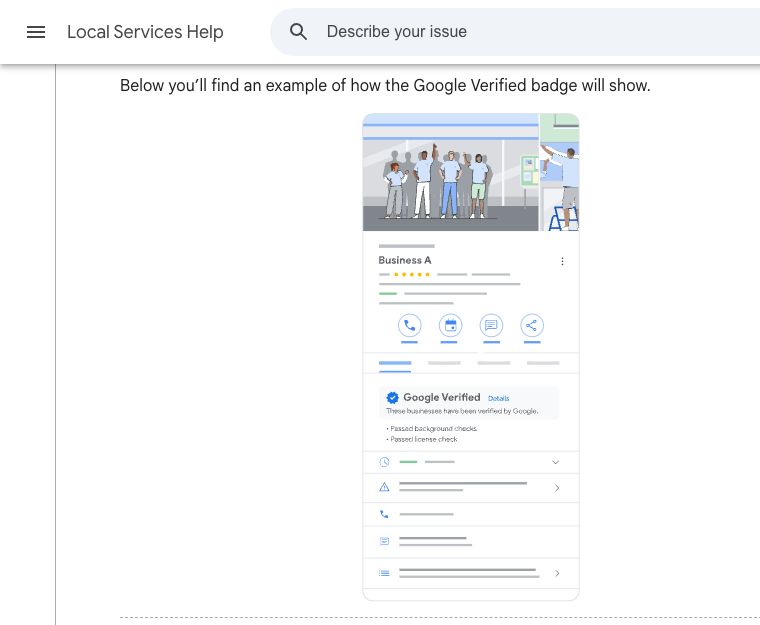
| Google Verified | The current unified verification badge. | Read the specific checks displayed on the provider profile. |
| Google Guarantee / Google Guaranteed | Google Guarantee named the former badge and associated money-back arrangement; Google Guaranteed described participating providers. | Historical terminology. The associated money-back guarantee has been discontinued. |
| Google Screened | A professional-screening label documented in older Google guidance. | Useful when reading older material; it should not be confused with the advertising product or a consumer reimbursement guarantee. |
Google’s legacy Google Guarantee definition uses “Google Guaranteed” for verified home-service advertisers. Its Google Screened definition describes professional screening. Older Google marketing also names License Verified by Google as a badge; that is another historical label, not the advertising product or proof of a current reimbursement promise. Historical wording in Google’s lead-generation article.
For current badging and the guarantee’s retirement, use Google’s current Google Verified notice. The former Guarantee help URL now redirects to that notice. Keeping an old definition or marketing article online does not restore the old reimbursement promise.
What changed from Google Guarantee to Google Verified?
Google Verified signals that a provider has completed Google’s required screening. Eligible existing advertisers receive the replacement badge automatically; new advertisers earn it by completing their requirements. Verification details appear on the provider profile. Google says the badge change itself does not alter ad ranking.
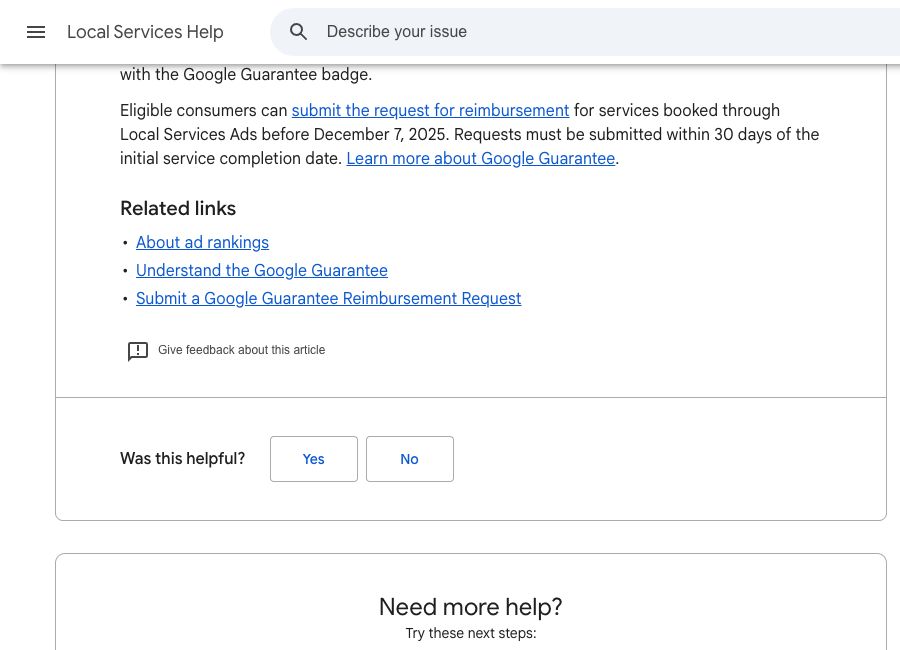
Google’s notice limits the old reimbursement arrangement to eligible services booked before December 7, 2025, with claims required within 30 days of initial service completion. For a new customer in 2026, the practical promise is verification transparency, rather than a Google-backed refund for the work. Source: Google Verified badge.
Why consider Local Services Ads?
Reach service searches
Your business has an opportunity to appear prominently for relevant local searches.
Make checks visible
The badge and profile let customers see the verification Google completed.
Pay for an enquiry
The charging event is a valid lead, rather than an ordinary ad click.
Customers select your profile to contact you. Your business still needs useful service information, responsive answering and a workable booking process. Visibility, lead volume and sales depend on your market and operation. The Google Verified badge is currently unavailable for auto, beauty and dining verticals, even where Local Services Ads are offered. Source: Google’s getting-started guide.
Pay per lead: what you actually buy
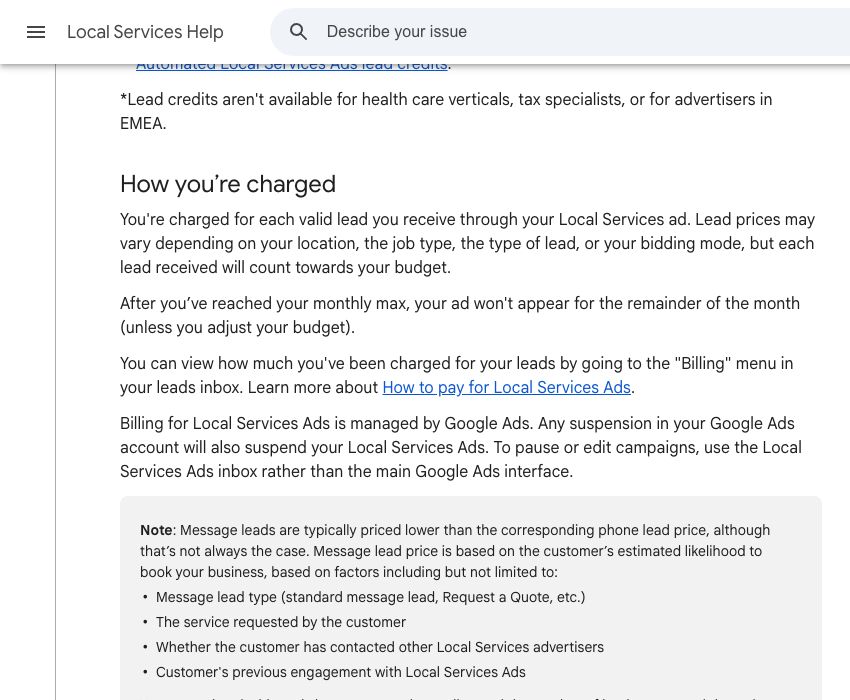
“Pay for a valid lead” is the accurate claim. A lead can be chargeable without becoming an appointment or sale. Prices depend on location, job type, lead format and bidding. Keep billable enquiries, qualified opportunities, bookings and completed jobs as separate stages in your records.
| Customer contact | What to expect |
|---|---|
| Answered call or connected callback | Can qualify as a billable lead. |
| Missed call in your business hours | Can be billable after more than 20 seconds on the line. IVR routing and active ad schedules affect this rule. |
| Message, email or voicemail | Can qualify; a sale is not required. |
| Booking request | A supported lead format in the US and Canada. |
| Repeat contact | Google describes a 15-day interaction window for the same phone number or email. |
Google assesses quality and may credit a charged lead. Its “How leads work” page describes reassessment over 30 days. Confirm the account’s charge status when reconciling spend. Source: how leads work.
A poor sales outcome does not create an automatic refund entitlement. Google’s dedicated automated-credit policy excludes healthcare verticals, tax specialists and advertisers in EMEA. It also says credits are no longer supported for “job type not serviced” or “geo not serviced”. Give lead feedback and keep service areas and job types accurate; do not budget on the assumption that every unsuitable enquiry will be refunded. Source: automated lead credits.
For your own reporting, compare advertising spend after credits with the number of booked jobs, then with completed profitable jobs. A lower cost per enquiry can still produce a more expensive booked customer if the team cannot answer or the scope rarely fits. See our guide to qualified contractor leads and minimum contractor CRM pipeline.
Country, region and profession: use the right level of evidence
The directory snapshots Google’s public category lists for Austria, Belgium, Canada, France, Germany, Ireland, Italy, Spain, Switzerland, the United Kingdom and the United States. A listed category is a starting point. Google directs businesses to its eligibility checker for their area.
Some limits are explicit. The US guide confines several categories, including architect and drain expert, to California and Florida. The UK guide lists its legal-services and estate-agent group for Greater London only. These are published restrictions, not proof that every address in those regions qualifies. US list; UK list.
Public Google pages do not always align. The Canadian getting-started list contains 16 categories, while its screening page includes a garage-door profile as well. The Canadian marketing landing page lists a broader selection. The directory keeps the source-specific distinction and leaves address eligibility unknown. Absence from a list is not a verified rejection. Canadian category list; Canadian screening profiles; Canadian landing page.
Ontario and California appliance repair: why scope matters
A trade qualification, a business registration, a municipal permission and Google screening answer different questions. Start with the actual work: a washing-machine control repair, a gas connection and a refrigerant-circuit repair should not share one undifferentiated licence answer.
Ontario
Skilled Trades Ontario classifies Appliance Service Technician as non-compulsory. Its Certificate of Qualification is voluntary and does not require renewal. That supports a narrow statement about this trade certificate; it does not establish that every appliance job or business needs no licence. Source: Skilled Trades Ontario.
- Gas and propane: TSSA regulates fuels contractors and certificate holders. A business registration and the workers’ appropriate certificates are separate requirements; the equipment and tasks determine the certificate scope. TSSA contractor and certification guidance.
- Refrigerants: Ontario requires Ozone Depletion Prevention certification for handling regulated refrigerants. The card lasts five years. An ODP card alone does not authorize refrigeration-equipment repair; check applicable trade qualifications. Ontario refrigerant rules.
- Electrical contracting: an ECRA/ESA contractor licence is generally required, with limited exemptions linked to particular qualifications and work. Fixed wiring needs its own scope assessment. ESA licensing guidance.
California
The Bureau of Household Goods and Services regulates major home-appliance repair dealers. Its appliance service-dealer application lists a US$190 fee per location and no exam or education prerequisite. This business/dealer registration is distinct from an individual trade qualification. BHGS requires a separate licence for each distinct DBA. BHGS applicant requirements; regulated repair scope.
BHGS renewal is annual, due by the expiration date; renewal payments cannot be submitted more than 45 days before expiration. Refrigerant work may separately require federal EPA Section 608 certification. Type I addresses small appliances; choose the certification for the equipment involved. Section 608 credentials do not expire. Construction, installation, gas piping, fixed wiring and local permits need additional scope-specific review; this guide has not completed that licensing determination. BHGS renewal; EPA certification.
Prepare the documents Google actually requests
Google’s country/category screening profiles identify possible business and owner licences, insurance and additional checks. Asterisks mean licences apply where local law requires them. Several checks are selective. Your account’s Business Verification screen determines what to submit. Keep legal names, trading names, addresses and licence details consistent. US requirements; Canadian requirements.
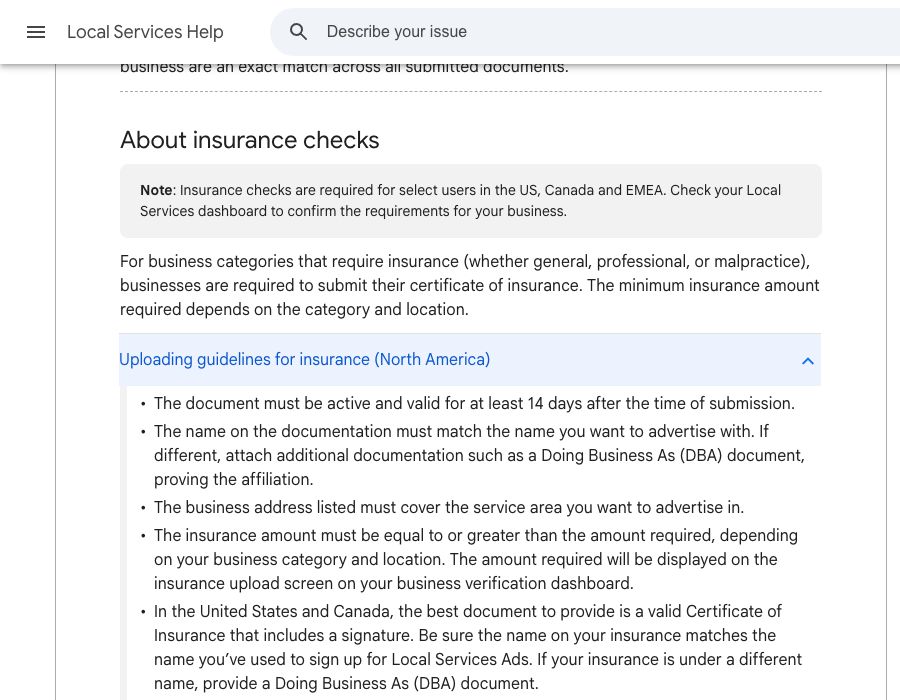
The “one month left on the licence” rule is unconfirmed. The current public guidance reviewed here does not establish a universal 30-day licence-validity minimum. It does state that North American insurance documents must remain active for at least 14 days after submission. Do not transfer that insurance condition to professional licences. Check any additional instruction in your account before uploading. Google’s insurance guidelines.
Insurance type and minimum limits vary by category and location. Use the upload screen’s required limit rather than a universal amount. North American certificates should include the policy number and matching business identity; a DBA document can explain a name difference. For Europe, Google describes public/general liability or professional indemnity documents and proof of recent payment for ongoing cover. Employer liability alone is not accepted as a substitute. Screening and insurance requirements.
- Open the LSA menu and select Business Verification.
- For a licence, choose Add details, select the type, enter the business name, number and expiry, and attach an image if requested.
- For insurance, choose Submit document beside Proof of Insurance, attach the document and save.
Healthcare providers have separate business general-liability and individual professional-liability uploads. Official upload instructions.
Background checks: follow your assigned process
Google describes background checks for selected businesses in the US and Canada. Depending on category and location, the checks cover the business, owners and customer-facing workers, including relevant contractors. They are not credit checks, and Google says businesses are not charged for them. The public guidance does not establish one universal criminal-check provider for every province and state. Google’s North American screening explanation.
- Check Business Verification for the people and business entities that need screening.
- Follow the invitation to the assigned partner. Each person reviews the required disclosures and gives consent before the check.
- Provide truthful information directly through that partner’s secure process. Add the required field-worker roster where requested.
- Resolve inaccuracies and appeal through the partner’s documented channel. Check completion status before relying on the badge.
A business representative’s identity check is a separate step: Google names Evident for that US check. Do not assume Evident is therefore every region’s criminal-record-check provider. Nor should an unrelated police certificate be assumed to replace Google’s assigned screening. Business representative checks.
After correcting errors and receiving a final disqualification decision, Google describes a 30-day wait before reapplying. After a second denied application, subsequent reapplications require a 180-day wait. Follow the partner’s appeal process rather than trying to bypass screening. Some categories also require Advanced Verification, which can include a video interview. Selected US advertisers may receive accelerated verification and then have 14 days to complete additional requested steps. These are distinct from document-expiry rules. Google’s screening and reapplication guidance.
In European country profiles reviewed here, Google describes business-registration checks and relevant insurance/licences. The North American criminal-check process should not be presented as a mandatory Europe-wide step. Example: Austria’s requirements.
A practical route from eligibility to launch
- Define the scope. Write down your genuine service area and exact job types. Resolve regulated work before advertising it.
- Check eligibility. Use Google’s official Local Services Ads entry point. A country-list entry alone does not confirm your address.
- Connect the correct Business Profile. Have an authorized owner or manager complete the link and verification.
- Complete the account’s checks. Submit only the registration, licence, insurance, identity and background-check items requested for the business.
- Plan the response. Decide who answers, how missed calls are handled, what scope questions are necessary and how bookings are recorded.
- Set budget and billing deliberately. Review bidding and monthly limits, then launch only when the business is ready to receive enquiries.
- Review outcomes. Reconcile charged and credited leads, bookings and completed jobs. Renew documents and complete any requested re-verification.
The public country screening pages describe a typical 3–4 weeks after document submission. Treat that as an estimate rather than an approval deadline. Google’s screening timetable. The article and directory do not initiate a registration, check or campaign.
Is there a $600 sign-up bonus?
On October 30, 2026, Google’s Canadian Local Services Ads landing page displayed Offer A: CAD$600 in ad credit after CAD$600 in qualifying advertising costs within the first 60 days. Its claim link led to Local Services Ads signup. This verifies an offer shown in that Canadian signup path; it does not establish eligibility for every account, country or type of advertising spend.
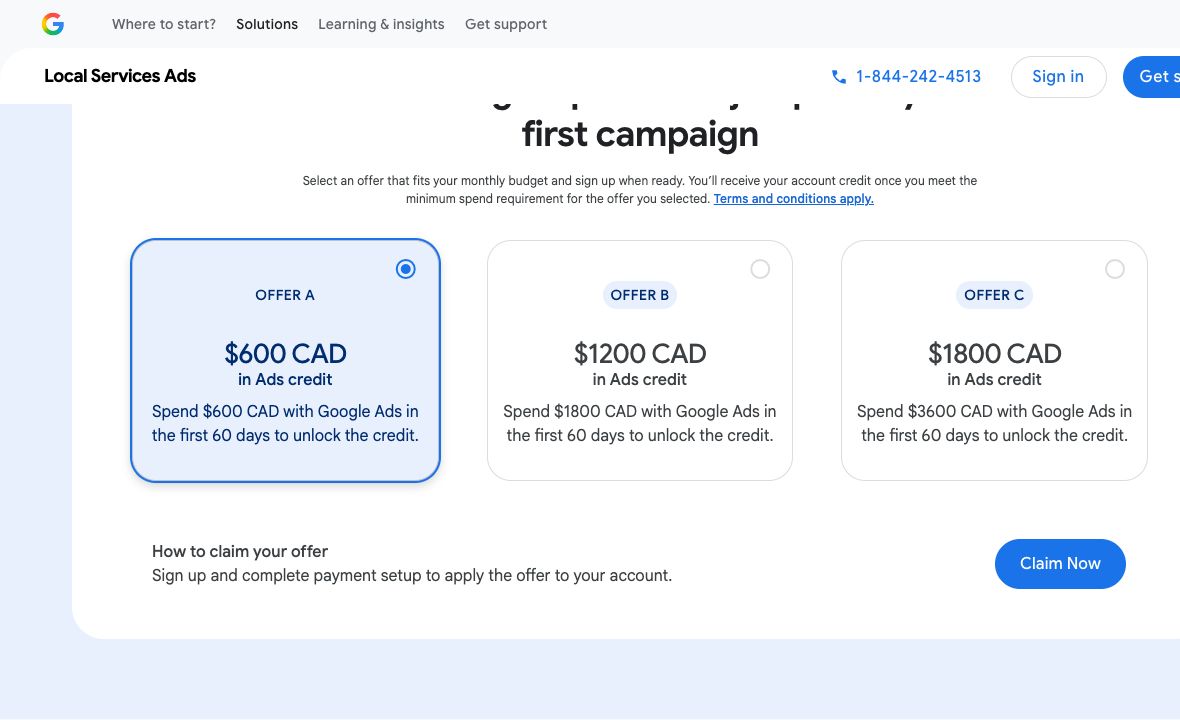
The terms linked to this rendered offer require a new Google Ads advertiser with a Canadian billing address, one promotional offer per advertiser, and a payment profile with a valid payment method during signup. The selected offer must be applied to the first Google Ads account during signup. Qualifying campaign costs must accrue after the offer is applied, within 60 days; a payment alone is insufficient. Taxes and fees do not qualify. Subject to checks, credit is typically applied within 35 days and expires 60 days after the credit is added. It applies to future advertising costs and is available while supplies last. Read the exact linked Canadian offer terms.
The linked terms describe Google Ads credit. Confirm that the same offer and intended LSA spend qualify in your signup and billing flow. Do not substitute another Search or Performance Max promotion, or describe the offer as an unconditional LSA discount.
How this guide and directory stay useful
Checked October 30, 2026. Next planned editorial review: April 30, 2027. Each directory record retains its official evidence, verification date, scope and unresolved questions. The review must revisit the badge, billing, credit policy, country category lists, screening and regulated-work sources before updating dates.
Coverage is deliberately visible: 497 country-guide listings, 400 matched category-screening profiles, and two regional appliance-repair scope records. Ninety-seven listings have no confidently matched individual screening profile in this snapshot. Regional legal coverage is partial; no address-level eligibility has been certified. A blank result or unknown field means that more evidence is needed. Use the directory’s filters and source links to find the next check.
Lead to Order publishes practical guides to help service-business owners make clearer decisions. This guide explains public requirements; it does not claim that the author has personally passed every check described, or that Google has endorsed Lead to Order.
Questions about the names and where to apply
Is Google Guaranteed the same as Google Verified?
They are related badge names from different stages of the programme. Google Verified is the current badge. The former Google Guarantee money-back arrangement was discontinued; the new badge should not be described as continuing that promise.
What does LSA stand for?
Local Services Ads. That is the advertising product, rather than a professional licence or the name of the former money-back guarantee.
Is Google Screened another name for Local Services Ads?
Google Screened is a screening label found in older Google documentation. A provider’s badge and the advertising product are different concepts, even when people use the terms loosely in searches.
Where do I apply directly with Google?
Start at Google’s official Local Services Ads registration page. Check eligibility and the current account requirements there. This guide’s link goes directly to Google and adds no affiliate or referral parameters.
Does verification guarantee enquiries or sales?
No. The badge communicates completed checks. Eligibility, ad delivery and the business’s conversion of enquiries into bookings remain separate questions.